

Solar & Daylight
Solar radiation, daylight hours and sky cover at the site, month by month.
Open Solar & Daylight from the left rail in Site Intelligence. It uses the same weather station as the Climate panel.
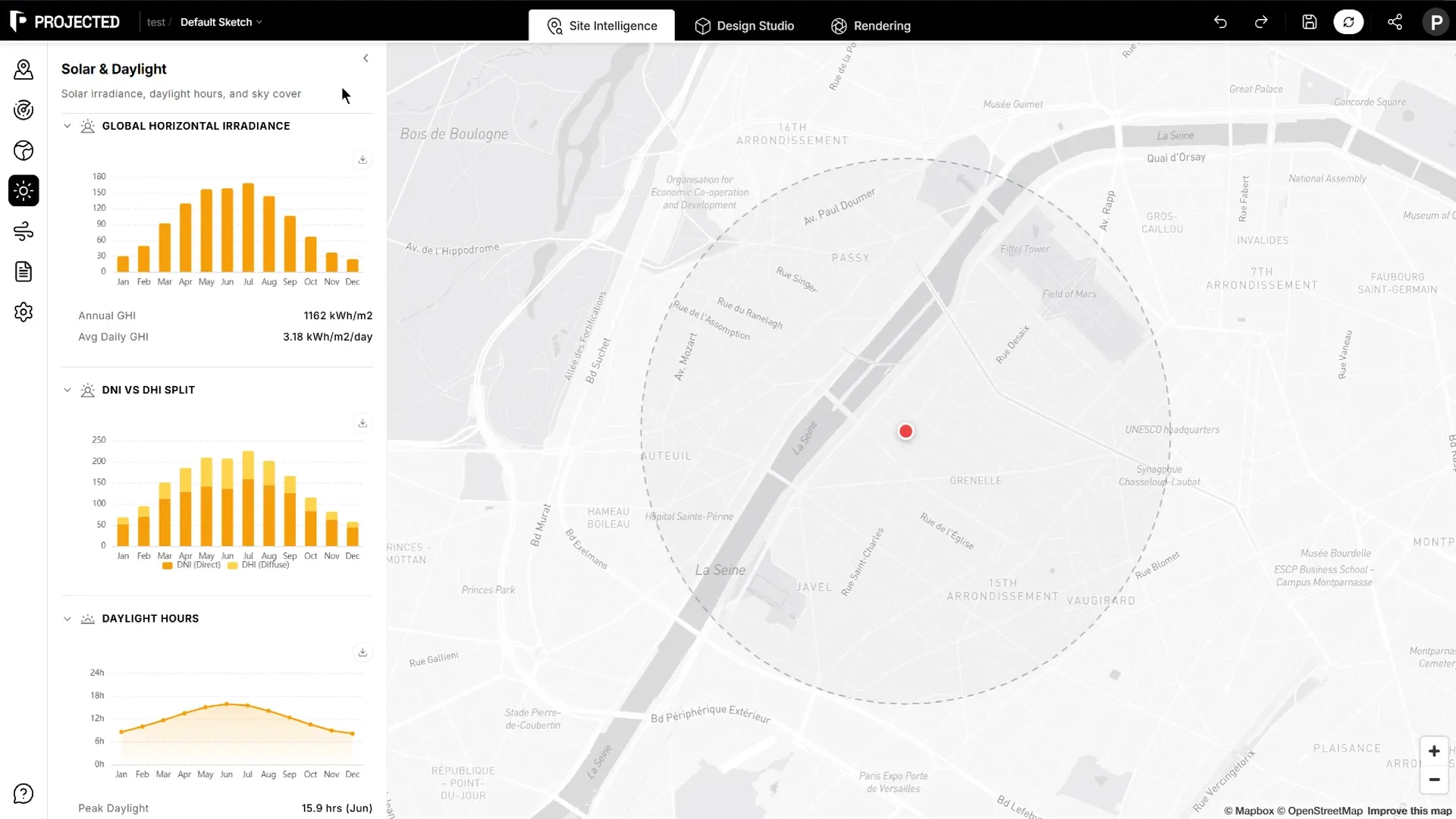
Global horizontal irradiance
Global horizontal irradiance (GHI) is the total solar energy reaching a horizontal surface, in kWh/m².
| Figure | What it means |
|---|---|
| Annual GHI | Solar energy received over the year. A first indication of the site’s solar potential, for example for roof photovoltaics. |
| Avg Daily GHI | The annual total divided by 365 |
The monthly chart shows how the solar resource changes through the year.
Direct and diffuse light
DNI vs DHI Split compares, month by month:
- DNI (Direct): sunlight coming straight from the sun’s disc. It casts shadows and drives solar gains through windows.
- DHI (Diffuse): light scattered by the sky and clouds. It lights rooms evenly, from every direction.
A site with a high diffuse share has an overcast climate: daylight comes from the whole sky, and orientation matters less.
Daylight hours
The length of the day in the middle of each month, from sunrise to sunset, with the Peak Daylight (longest) and Min Daylight (shortest) values.
Sky cover
Monthly Mean Cloud Cover on a scale from 0 (clear) to 10 (overcast). Higher values mean more diffuse light and less direct sun.
Related
- See how buildings shade each other at any date and time in the Shadow Study.
- The Carbon Analysis uses this solar data for window gains and roof photovoltaics.